
The 2026 Atlantic hurricane season opened today, June 1, and the National Oceanic and Atmospheric Administration (NOAA) is forecasting a below-normal year: 8 to 14 named storms, a strengthening El Niño, fewer systems than the long-term average. For a business owner weighing whether to pursue FEMA disaster contracts, that forecast is the wrong thing to anchor on. A few days before the season opened, Federal News Network published a conversation with Stephanie Kostro of the Professional Services Council under a headline that captures the entire point: some of the most important parts of disaster response happen long before anything goes wrong.
That is not a sentiment. It is how federal disaster contracting actually works, and the businesses that understand it are already in the system while everyone else waits for a storm to appear on the radar.
FEDCON sits in Tampa, so this is not theoretical. In 2024, thirteen days brought our region two storms back to back, Helene and then Milton, in one of the worst stretches Tampa Bay has seen in decades. The needs afterward were immediate and physical: debris hauled off roads, tarps and roofing on damaged homes, generators and temporary power, bottled water, sanitation, cleanup, rebuilding. The scale is hard to picture until you see the numbers. For Helene and Milton in Florida, FEMA obligated $589.9 million for debris removal alone, funding the haul-off of more than 31.67 million cubic yards of disaster debris, part of more than $11 billion FEMA provided across the two storms.
And the damage did not stop at the coast. Helene drove historic rainfall and record flooding hundreds of miles inland across western North Carolina, where landslides buried roads, bridges washed away, and towns like Asheville were cut off. NOAA puts Helene's total cost at $78.7 billion, making it the deadliest hurricane to hit the U.S. mainland since Katrina. Every washed-out road and collapsed bridge is a recovery contract. Every one of these needs is work a capable business can do, and much of it is work the government pays contractors to deliver. The question is whether a business is positioned to be one of them.
A Quiet Forecast Is a Trap
A below-normal season is not a no-storm season. NOAA's outlook still puts the range at up to 14 named storms and as many as three major hurricanes, and it takes exactly one to put a county under a federal disaster declaration. The number that should matter to a business owner is not the seasonal forecast. It is the fact that one bad week can erase a calm year.
Hurricanes are also not the only disasters that move federal money. Wildfires, floods, winter storms, droughts, and public health emergencies all trigger response and recovery work, and none of them follow the hurricane calendar. When a disease outbreak hits a federal facility, a military base, or an emergency shelter, the government pays contractors to disinfect, decontaminate, and manage the biohazard cleanup. The Centers for Disease Control, the Department of Homeland Security, and state health agencies all buy goods and services when something goes wrong. A business that can move supplies, clean a facility, build a temporary structure, haul debris, or stand up logistics is useful regardless of which kind of disaster created the need.
| Disaster | Work It Creates |
|---|---|
| Hurricanes | Debris removal, temporary roofing, emergency power, bottled water |
| Flooding | Water removal, remediation, hazardous cleanup, rebuilding |
| Wildfires | Debris and ash removal, hazmat cleanup, infrastructure repair |
| Drought | Water hauling and distribution, logistics, supply transport |
| Winter Storms | Snow and ice clearing, emergency power, temporary shelter support |
| Health Emergencies | Medical supply, PPE, sanitation, facility cleaning, logistics |
Every disaster type creates federal and state contracting needs. The work outlasts the storm.
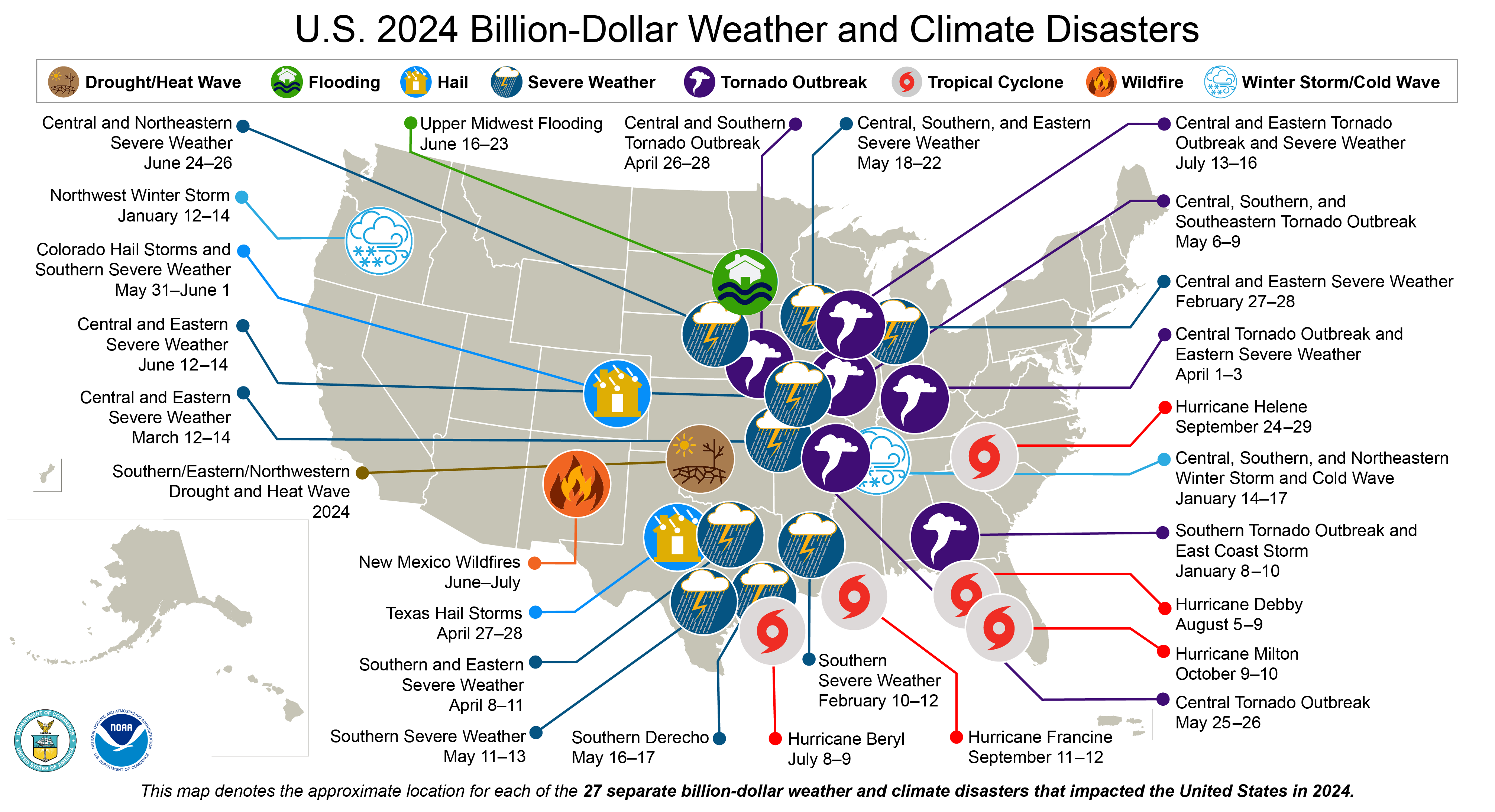
In 2024 alone, the United States saw 27 separate billion-dollar weather and climate disasters, spread across the entire country, not just the coasts. NOAA map by NCEI.
The Contracts Are Awarded Before the Storm
Here is the part most capable businesses never learn until they have missed it: the federal government does not wait for a disaster to go shopping. It buys the response in advance.
FEMA runs what it calls advance contracts, defined on its own website as agreements "competed and awarded in advance of major disaster declarations to provide efficient, cost-effective means for rapid delivery of supplies and services for recurring disaster response and recovery requirements." As of fiscal year 2026, FEMA holds 98 advance contracts across 44 mission-essential areas, covering temporary housing, base camp operations, logistics, and hazard mitigation. Those awards were settled before the season opened.
The U.S. Army Corps of Engineers does the same thing, and at scale. Under the National Response Plan, the Corps owns Emergency Support Function #3, public works and engineering, which means its missions include "ice, water, debris removal/reduction, temporary power, and temporary roofing." The Corps states plainly that these contracts have been awarded in advance, predominantly as IDIQ or requirements contracts, through its Advanced Contracting Initiative. The commodities are specific: bottled water, packaged ice, debris removal, temporary roofing, generator installation. A business that supplies any of those is supplying a market that is funded and contracted ahead of the weather.
The spending behind this is real. In the Federal News Network conversation, Kostro put FEMA's annual contracting spend at roughly $1.5 billion out of a budget of about $30 billion, and that figure does not count the Corps of Engineers work or the contracts that state and local governments award on their own. The takeaway is the same either way: a business cannot register its way into this market after a declaration. The window is open now.
The Law Tells the Government to Prefer Local Businesses
This is the detail that should change how a regional business thinks about disaster work. Under the Robert T. Stafford Disaster Relief and Emergency Assistance Act, the federal government is directed to favor local firms. In the Army Corps' own words, "a preference to the extent feasible and practicable shall be given to those contractors residing or doing business primarily in the area affected by a major disaster or emergency."
A contractor based in or near the disaster zone is not just convenient for the government. There is a statutory preference for hiring that business when a declaration is active. For a regional construction, logistics, sanitation, or supply company, that preference is a genuine competitive advantage, but only for a business that is registered, vetted, and findable before the declaration is signed. The preference does nothing for a company the contracting officer cannot locate.
The Market Is Shifting Toward States and Localities
A set of FEMA reforms under discussion would push more disaster responsibility down to states and localities, including block grants that release at preset impact thresholds and a shift in the federal cost-share for some disasters from 75 percent toward 50 percent. The specifics will keep moving, but the direction is clear: more of the disaster dollar is going to flow through state and local governments rather than only through Washington.
For a business getting ready, that is an argument for building relationships at more than one level. Kostro's advice to contractors is to diversify the customer base, and it applies directly here. A company registered for federal work, known to its state emergency management agency, and on file with its county procurement office has multiple paths to the same disaster, instead of betting everything on a single federal door.
What a Capable Business Should Do Before the Next Declaration
For a business that could do this work but has never contracted with the government, the sequence below is where FEDCON starts. None of it requires a storm on the radar, and all of it is harder to complete once one is.
Register in SAM.gov, then join the Disaster Response Registry. SAM.gov is the federal government's contractor registry, and registration is mandatory before a business can bid on any contract. FEMA is direct about it: a business "does need to be registered in SAM.gov." The registration itself is detailed, and getting the entity validation, NAICS codes, and representations right the first time saves weeks of back-and-forth. The step most companies miss comes next. SAM contains a Disaster Response Registry, described by the Army Corps as "a database of contractors willing to perform debris removal, distribution of supplies, reconstruction, and other disaster or emergency relief activities." Contracting officers search that registry to find vendors during a declaration. A business that skips it is invisible at the exact moment the work appears.
Choose NAICS codes that match real capability. NAICS codes are how the government categorizes a business, and disaster work has its own. Debris hauling falls under 562119, hazardous cleanup and remediation under 562910, emergency relief services under 624230, post-disaster facility cleaning under 561720, and portable sanitation under 562991. Construction, logistics, and IT carry their own codes. The right approach is to claim the codes that describe genuine capability, not the ones that sound impressive.
Certify any set-aside eligibility. A woman-owned, service-disabled veteran-owned, HUBZone, or 8(a) small business has a meaningful share of federal contracts reserved for it. Set-aside status widens what a company can win and is worth certifying before the need arises rather than during a scramble.
Build a capabilities statement that names disaster work. A capabilities statement is a one-page federal resume. Past performance on emergencies, flood cleanup, shelter supply, or crisis logistics belongs at the front of it. Contracting officers and prime contractors read these documents to decide who to call when a mission lands.
Line up teaming partners for the gaps. No business has to do everything alone, and FEMA encourages the opposite: "if you are strong in one business area, but inexperienced in another, find a subcontractor or teaming partner who can compensate in your areas of weakness." Subcontracting under an established prime is one of the most realistic ways for a newcomer to put real disaster-response past performance on the record.
The Bottom Line
The businesses that win disaster work in September registered in February. They claimed their codes, certified their set-asides, joined the right registries, and built the relationships before anyone needed them. The forecast does not change that math. A quiet season is precisely when getting ready feels optional, and precisely when the prepared business pulls ahead of the one that waits for the storm.
FEDCON helps businesses position for disaster-response work before the next declaration. If your company can do this work but is not yet set up to win it, contact our team or call the FEDCON Help Desk at 1-855-233-3266. Our consultants can map your path through SAM registration, NAICS code selection, set-aside certification, and a disaster-ready capabilities statement.