Marking your business as woman-owned or veteran-owned in SAM.gov is a checkbox. Getting certified by the Small Business Administration (SBA) is an application, and the certification is what opens the contracts set aside for those businesses.
Most owners stop at the checkbox. When FEDCON compared about 266,000 recently renewed SAM registrations with SBA's records, about 68,000 businesses had marked themselves woman-owned. Only about 12,000 of them held SBA's women-owned certification. Of the roughly 40,000 that marked themselves veteran-owned, about 18,600 were certified.
SBA runs four certification programs, and only small businesses can hold them: the 8(a) Business Development program, the Women-Owned Small Business program (WOSB and EDWOSB), the Historically Underutilized Business Zone program (HUBZone) and the Veteran-Owned and Service-Disabled Veteran-Owned Small Business program (VOSB and SDVOSB). Each one reserves contracts that firms without the certification can't bid on.
Small business certifications
| Certification | Who qualifies | What it opens up |
|---|---|---|
| 8(a) | Socially and economically disadvantaged owners | Set-asides and sole-source awards for nine years |
| WOSB / EDWOSB | Women own and control at least 51% | Set-asides and sole-source awards in designated industries |
| HUBZone | Main office in a HUBZone, and 35% of employees live in one | HUBZone set-asides |
| VOSB / SDVOSB | Veterans own and control at least 51% | SDVOSB: set-asides and sole-source awards governmentwide. VOSB: mainly at the VA |
A firm that qualifies for more than one can hold more than one. A woman-owned business with its main office in a HUBZone can be certified as both. Once SBA has a complete application, its stated timelines run from about 30 days for veteran certification to 90 days for 8(a) and WOSB.
8(a) Business Development
The 8(a) program is for small businesses owned and controlled by people who are socially and economically disadvantaged. Owners make an individual, written case that they meet SBA's standard for social disadvantage.
Admitted firms can win set-aside contracts and sole-source awards, which an agency can give to an 8(a) firm without competing the work. The program has a fixed length. Under SBA's regulation, a participant gets "a program term of nine years from the date of SBA's approval letter." The clock starts at approval, not at the first contract, so when a firm applies is part of the decision.
Women-Owned Small Business (WOSB and EDWOSB)
A business qualifies as a WOSB when it is at least 51% owned and controlled by women who are U.S. citizens. If those owners are also economically disadvantaged, the firm can certify as an EDWOSB. An EDWOSB can bid on both WOSB and EDWOSB set-asides.
What the certification opens depends on the industry. A contracting officer can set work aside for women-owned firms only in industries where SBA has found them underrepresented in federal contracting. A WOSB certification is worth the most to a firm whose NAICS codes fall in those industries.
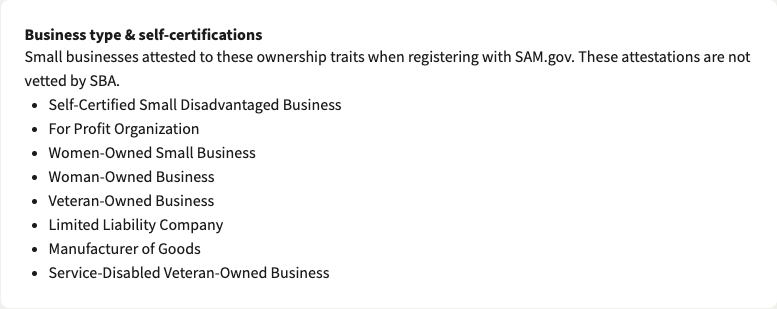
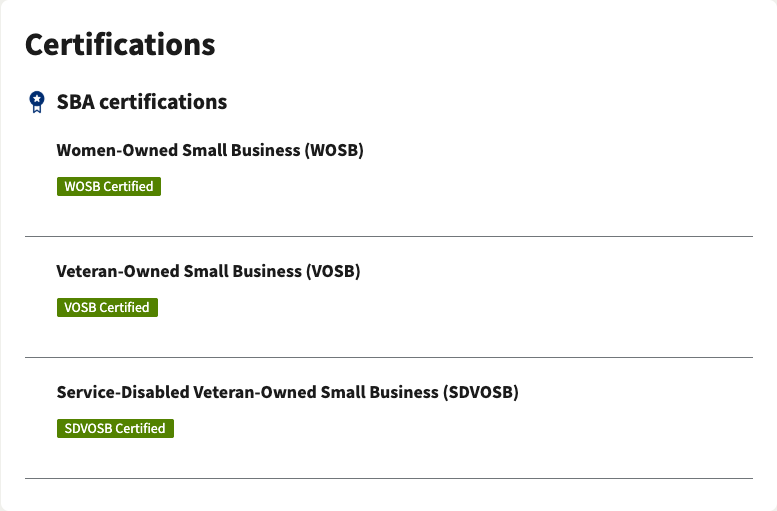
Marking the business as woman-owned in SAM is a self-certification. On SBA's Small Business Search (SBS), where buyers look up small businesses, it shows under self-certifications with a note that SBA has not vetted it. A WOSB set-aside needs the SBA certification, which shows in its own section of the profile as "WOSB Certified."
Historically Underutilized Business Zone (HUBZone)
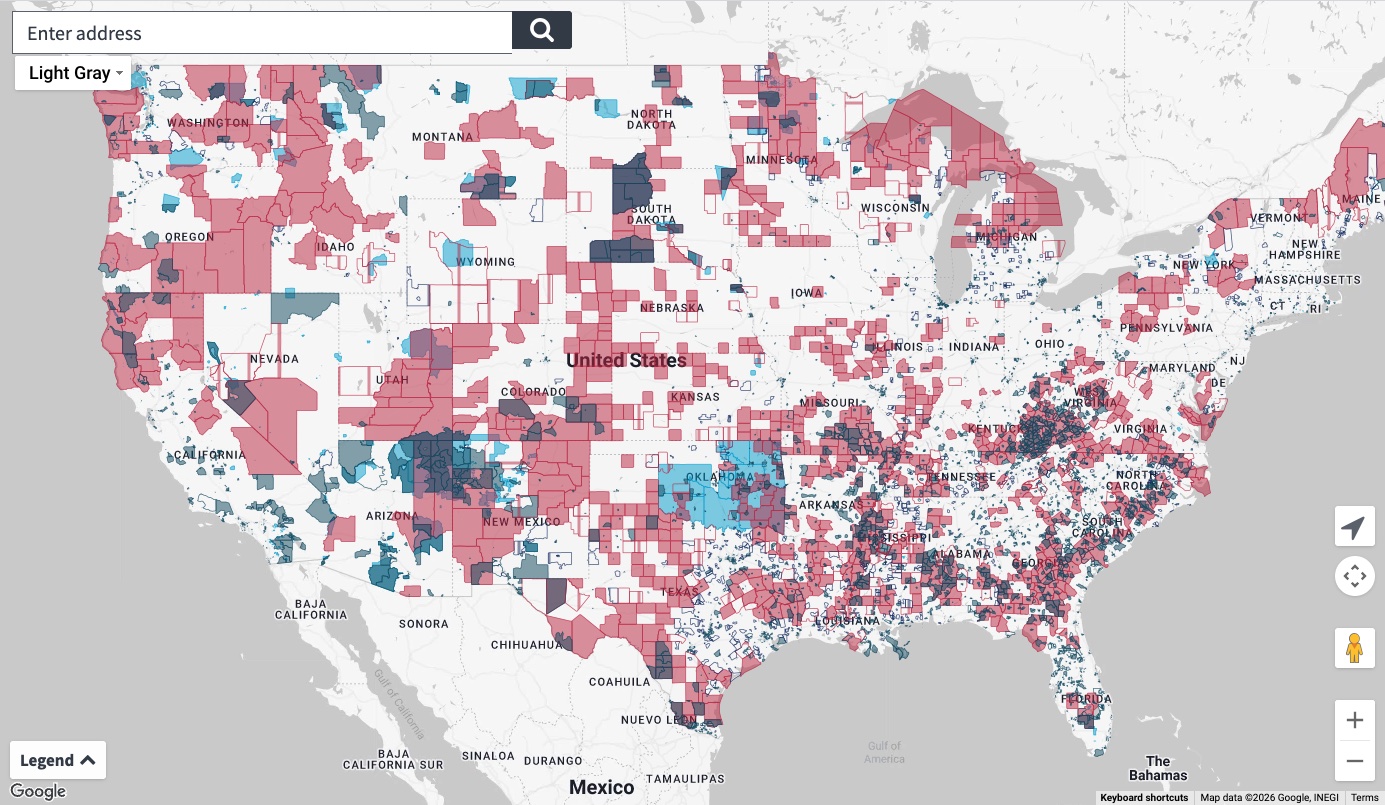
HUBZone certification is for small businesses with their main office in a Historically Underutilized Business Zone and at least 35% of employees living in one. Certified firms can bid on contracts set aside for HUBZone firms.
The two tests behave differently. The office test is the one owners check first, and it stays put unless the company moves. The employee test changes every time the company hires. A firm that adds staff who live outside the zone can drop below the line without moving anything.
HUBZone boundaries also change when SBA updates its map, so an address that qualifies today may not qualify later. HUBZone firms recertify every three years.
Veteran-Owned and Service-Disabled Veteran-Owned (VOSB and SDVOSB)
SBA's veteran certification covers businesses at least 51% owned and controlled by veterans (VOSB) or by service-disabled veterans (SDVOSB). SDVOSB certification opens set-aside and sole-source contracts across the federal government.
Marking the business as veteran-owned or service-disabled veteran-owned in SAM is also a self-certification. To bid on an SDVOSB set-aside, a firm has to be certified by SBA, and its SBS profile then lists it as "SDVOSB Certified."
Certifications a contract can call for
Some certifications come from the type of work, not from who owns the business. None of them is needed to bid in general. Each one matters only when a contract asks for it.
| Certification | What it is | Where it comes up |
|---|---|---|
| DBE | A state and local certification for transportation work, separate from SBA's programs | State DOT, transit and airport contracts |
| CMMC | A cybersecurity certification for defense work | Defense contracts; the solicitation states the level |
| ISO | A certification that a firm meets a quality or security standard | Manufacturing and technology contracts |
| License and bonding | A state trade license and a surety bond | Construction and trade contracts |
What isn't a certification
A GSA Schedule is a contract, not a certification. It lets agencies buy from a firm at prices and terms already negotiated, and any eligible business can pursue one, certified or not.
A women's business enterprise (WBE) certificate isn't the federal WOSB certification. WBE certificates are used mainly in corporate supplier programs, and on their own they don't qualify a firm for WOSB set-asides.
APMP certifies people who write proposals. It isn't something a contract asks a business to hold.
Where firms get stuck
The first place is SAM itself. Before a registration goes active, SAM confirms the business's legal name and physical address against an official document. In its entity validation guide, the government lists the most common reasons those documents get rejected: the document is an application or web form rather than a certified record, it is too old, or the name or address on it doesn't match what was entered in SAM. A P.O. box doesn't count as a physical address.
SBA certifications have their own version of the problem. Under SBA's WOSB rule, SBA "must receive all required information and supporting documents before it will begin processing" an application. If what a firm submits is inconsistent and SBA can't confirm the firm meets every requirement, SBA declines it.
A decline costs time. A declined firm has to wait 90 calendar days before it can apply again, and that is true in all four programs. One missing or mismatched document can push a firm's first set-aside bid back by months.
Frequently asked questions
Can I bid on federal contracts without a certification?
Yes. An active SAM.gov registration with the right NAICS codes is enough for contracts open to everyone. A firm that fits SBA's size standard for its industry can also self-certify in SAM as small and bid on contracts set aside for small businesses. Certifications only matter for contracts reserved for 8(a), WOSB, EDWOSB, HUBZone, VOSB or SDVOSB firms.
Does a large business need a certification to bid?
No. A large business needs an active SAM.gov registration and bids on contracts open to everyone. It cannot bid on small business set-asides, and SBA's four certifications are only for small businesses.
What is the easiest government contract to bid on?
Purchases under the simplified acquisition threshold, currently $350,000, use simpler buying procedures. Above the smallest purchases, they are set aside for small businesses whenever at least two capable small businesses are expected to compete. No certification is needed, and on these purchases a buyer can choose which businesses get asked to quote.
How long does SBA certification take?
It depends on the program, and the clock starts once SBA has a complete application. SBA's stated timelines are about 30 days on average for veteran certification (VOSB and SDVOSB), 60 days for HUBZone, and 90 days for 8(a) and for WOSB. An application missing documents takes longer.
What happens if SBA declines my certification application?
In all four programs, a declined firm has to wait 90 calendar days from the date of the decision before it can apply again, and the new application has to show it has overcome every reason for the decline.
Do I need CMMC to bid on defense contracts?
Only when the contract calls for it. The solicitation states the CMMC level required.
Is a certification worth it?
A certification is worth pursuing when a firm qualifies for it and the agencies it wants to sell to actually set work aside under that program. That second part shows up in how those agencies have bought the firm's kind of work before.
If your SAM registration or a certification application has stalled, come back declined, or you're not sure what's missing, talk to a FEDCON advisor.